
Amazon is hiring more people right now than almost any other company in America: in October 2026, the company announced more than 300,000 seasonal, part-time and full-time openings across its US operations network — and unlike most big employers, it does not ask warehouse applicants for a resume or a traditional interview. If you need work fast, that combination is hard to beat.
This guide to Amazon jobs 2026 covers the numbers that actually matter: what Amazon pays per hour, which roles are open, what benefits start on day one, and the exact apply process from the first click to your first day. Every pay figure comes from Amazon’s own announcements or the US Bureau of Labor Statistics.
Quick Answer
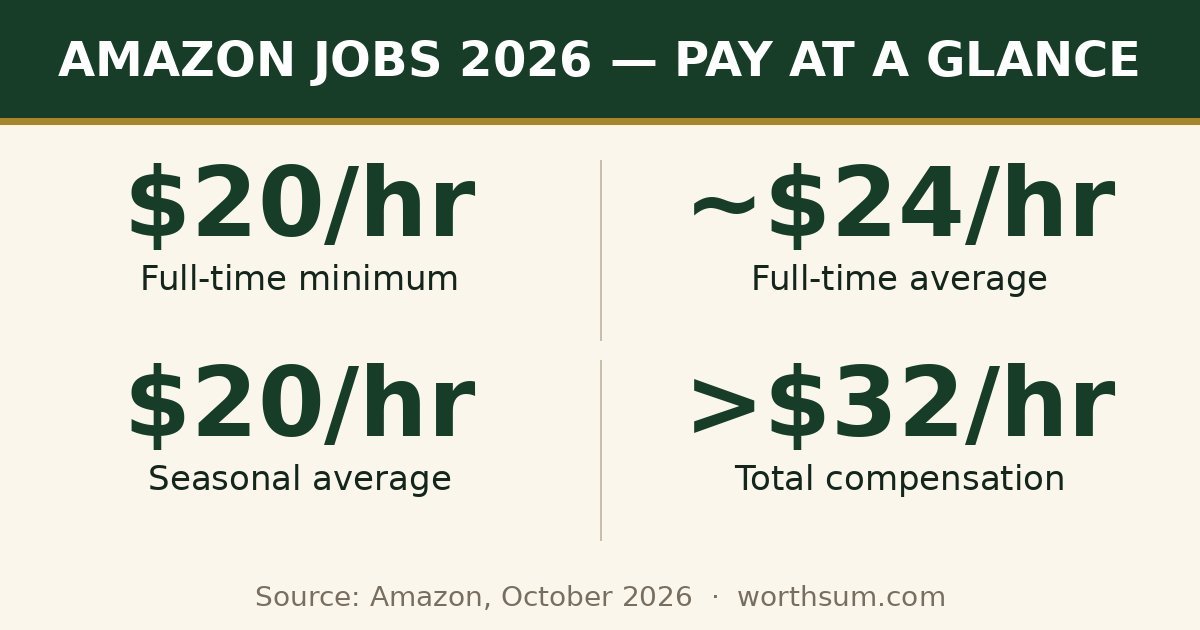
Amazon jobs 2026 include more than 300,000 seasonal, part-time and full-time US openings for the holiday season. Full-time operations roles start at a minimum of $20 an hour, with average pay of nearly $24 an hour. Most warehouse roles need no resume and no interview — apply online, attend a pre-hire appointment, and start after your checks clear.
| Fact | Detail |
|---|---|
| Openings (2026 holidays) | 300,000+ seasonal, part-time and full-time US roles |
| Full-time minimum starting pay | $20/hour |
| Full-time average pay | Nearly $24/hour |
| Average total compensation (with benefits) | Over $32/hour |
| Seasonal average pay | $20/hour |
| Resume needed (warehouse roles) | No |
| Interview (most hourly roles) | No — drivers do require one |
| Minimum age | 18 |
| Healthcare | Day one for regular staff; seasonal (30+ hrs/wk) from Jan 1, 2027 |
| Where to apply | hiring.amazon.com (hourly) or amazon.jobs (corporate) |
| Research date | 19 November 2026 |
How Much Do Amazon Jobs Pay in 2026?
The short answer: Amazon pays above the warehouse-industry average, having raised pay twice in two years to get there. The longer answer depends on the role, the building, the shift and the city — so treat every figure below as Amazon’s published anchor and confirm the exact rate on your listing.
Amazon’s own announcement from October 20, 2026 sets the current numbers for Amazon jobs 2026. Full-time employees in the company’s core operations roles start at a minimum of $20 an hour, and average hourly pay across that workforce is nearly $24 an hour. With the value of benefits included, average total compensation passes $32 an hour.
That $20 floor is new: in September 2025, Amazon announced a pay increase of more than $1 billion that lifted average pay for fulfillment and transportation workers to more than $23 an hour, with total compensation above $30 an hour. The average worker gained about $1,600 a year from that change. Then in September 2026, Amazon raised pay again — by more than $1.5 billion — and the minimum starting wage for full-time operations roles reached $20 an hour.
Rates also changed as recently as September 27, 2026, when Amazon’s hiring site posted new hourly rates — check the exact figure on your listing when you apply and again when the offer arrives.
| Role or track | What Amazon says it pays | Notes |
|---|---|---|
| Full-time operations (warehouse, sortation, delivery station) | Minimum $20/hour; average nearly $24/hour | Published anchor, October 2026 |
| Seasonal roles | Average $20/hour | Can convert to full-time |
| Average total compensation (full-time, with benefits) | Over $32/hour | Pay plus benefits value |
| Night / weekend shifts | About $1–$2/hour above the base rate | Varies by site |
| Delivery driver (via Delivery Service Partner) | Set by the partner, not Amazon | Employed by the partner |
How Amazon’s pay compares with the national median
The US Bureau of Labor Statistics puts the national median wage for laborers and freight, stock, and material movers, hand — the occupation covering most warehouse work — at $40,240 a year, or about $19.35 an hour (May 2025 estimates), with about 2.94 million people in the occupation.
Stack Amazon’s numbers against that median and the gap is clear. At the $20 minimum, a full-time Amazon worker already earns above the national median for the same kind of work; at the average of nearly $24 an hour, that is roughly $50,000 a year before overtime — about 24% above the median — and total compensation of more than $32 an hour is roughly 65% above it.
| Measure | Amount |
|---|---|
| BLS national median, warehouse laborers (May 2025) | $19.35/hour ($40,240/year) |
| Amazon full-time minimum (Oct 2026) | $20/hour |
| Amazon full-time average (Oct 2026) | Nearly $24/hour |
| Amazon average total compensation with benefits | Over $32/hour |
One caveat: the BLS median covers every warehouse employer in the country, including small operators in low-cost areas, while Amazon’s figures are its own national averages. Your local rate depends on your metro area, and the listing for your ZIP code is the only number that counts — but the direction is consistent, with Amazon’s published pay above the middle of the market.
Seasonal hiring keeps growing
Amazon’s holiday hiring has grown every year since 2024, and the 2026 number is the largest yet: 250,000 seasonal workers in 2024, another 250,000 in 2025, and more than 300,000 in 2026.
| Holiday season | Seasonal hires announced |
|---|---|
| 2024 | 250,000 |
| 2025 | 250,000 |
| 2026 | 300,000+ |
Seasonal work is also the most common way in: Amazon says seasonal employees regularly move into full-time roles, then into trainer, manager and leadership positions. If you take a seasonal job and perform well, the path to a permanent role is real — it is how a large share of Amazon’s operations managers started.
What Amazon Jobs Are Available in 2026?
Amazon groups its hourly jobs by the type of building you work in, and the work is physical in every one of them: expect to stand, walk, bend and lift for most of a shift, and to lift up to 49 pounds. No previous experience is needed — training is provided on the job.
The fulfillment center associate is the role most people picture when they think of Amazon jobs 2026. Fulfillment centers are where customer orders are put together: associates receive and put away inventory, pick items from shelves, pack them, load boxes onto trucks, unload freight and process returns. Free training can also qualify you to operate forklifts, reach trucks and order pickers. Schedules run from full-time at 40 hours a week down to flex time of as little as 4 hours a week.
Sortation center associates sort packed orders by ZIP code so they can go out for delivery — taking packages from conveyor belts, scanning, stacking, wrapping pallets and loading trailers. Full-time and part-time schedules of 20 to 29 hours are offered.
Delivery station associates work at the last stop before an order reaches the customer’s door: they receive trucks full of packages, sort them, build and wrap pallets, and prepare the loads drivers collect. Shifts are mainly early morning and overnight, because packages have to be ready before drivers set out.
Grocery warehouse associates fill online grocery orders, from pantry items to frozen food: preparing orders for delivery, receiving and putting away new stock, carrying out quality checks and rotating between tasks during the week. Work areas include room-temperature, refrigerated and freezer spaces, with freezers as cold as −10°F, and some shifts come with three-day weekends.
Warehouse equipment operators drive powered industrial trucks — stand-up forklifts, reach trucks and order pickers — to store, retrieve and move pallets. They also load and unload trailers and keep inventory records with handheld devices. Amazon provides the full training at no cost, so the role is a practical way to gain a forklift certification free.
Airport warehouse associates work at Amazon Air cargo sites, indoors and outdoors: sorting packages, loading containers, preparing and loading cargo for aircraft, and unloading arriving flights. No experience is needed and training is free; some airport roles require a valid driver’s license, and schedules are fixed weekly.
Delivery drivers deserve a separate note: they are not Amazon employees. The drivers in Amazon-branded vans work for Delivery Service Partners — independent local businesses Amazon contracts with — so your employer, pay and benefits are set by the partner and vary from one company to another. Amazon says drivers can expect a delivery vehicle with fuel and insurance provided, and opportunities to advance. You apply to the partner, not to Amazon.
| Role | What you do | Schedule | Experience needed |
|---|---|---|---|
| Fulfillment center associate | Pick, pack, stow, receive, load | Full-time to flex | None |
| Sortation center associate | Sort by ZIP code, scan, palletize | Full- or part-time | None |
| Delivery station associate | Sort loads for drivers | Early morning / overnight | None |
| Grocery warehouse associate | Fill grocery orders | Varies; some 3-day weekends | None |
| Warehouse equipment operator | Forklift / reach truck | Full-time | None (free certification) |
| Airport warehouse associate | Sort, load air cargo | Fixed weekly | None (some need a license) |
| Delivery driver (via partner) | Deliver packages | Set by the partner | Varies by partner |
| Corporate / tech roles | Office / engineering / AWS | Salaried | Yes |
What Benefits Do Amazon Employees Get?
Benefits are the main reason many workers choose Amazon over smaller warehouses with similar hourly rates. For regular employees working 30 to 40 hours a week, the package starts on day one: medical, dental and vision coverage, mental health support, paid time off and company holidays, a 401(k) with matching contributions, free life and disability insurance, and employee discounts.
The most valuable benefit for many workers is Career Choice: after 90 days, the program pre-pays tuition of up to $5,250 a year for degrees, GEDs, ESL courses and certificates in healthcare, IT, transportation and skilled trades. Amazon’s Career Choice program pays for new skills, and that kind of skill-building is the same ladder that creators like Ryan Trahan climbed when a simple idea became a real business. Seasonal workers who move into permanent roles get the same access.
Healthcare is where Amazon changed the rules most recently: regular full-time employees have had it from their first day for several years, and from January 1, 2027, it extends to seasonal employees who work at least 30 hours a week — with plan options starting at $5 a week and $5 copays. Anyone hired into a qualifying seasonal role before that date gains access on January 1; those hired on or after it get coverage from day one.
In October 2026, Amazon gave US employees an uncapped 10% discount on eligible groceries and everyday essentials on Amazon.com and Whole Foods Market online, plus 20% uncapped in Whole Foods Market stores, including the hot bar and salad bar. A benefit called Day 1 Financial gives qualified employees and their families access to low-cost banking through First Tech Federal Credit Union, with membership they can keep for life. Access began rolling out in late 2026 and becomes broadly available in 2027.
Part-time and flex employees receive a smaller set of benefits — the exact package depends on your location, hours, tenure and whether the job is regular or seasonal.
| Benefit | Who gets it | Detail |
|---|---|---|
| Medical, dental, vision | Regular employees (30–40 hrs/week) from day one | Seasonal (30+ hrs/wk) from Jan 1, 2027 |
| Health plan cost | Entry-level plan from $5/week, $5 copays | Copays down 87% for select visits |
| 401(k) | Eligible employees | Company match |
| Career Choice tuition | After 90 days of employment | Up to $5,250/year |
| Free Prime membership | Eligible employees | Included |
| Grocery discounts | US employees | 10% online; 20% in Whole Foods stores |
| Paid time off + holidays | Regular employees | Accrues from start |
| Paid parental leave | Eligible employees | Included |
| Mental health support | All eligible employees | 24/7 support |
| Day 1 Financial banking | Qualified employees and families | Low-cost banking for life |
| Anytime Pay | Hourly employees | Early wage access |
| Safety shoe credit | Warehouse associates | Up to $110 |
How Do You Apply for an Amazon Job?
Applying for Amazon jobs 2026 is deliberately simple, and the hourly application is the fastest part of the whole process. Amazon’s own hiring site is hiring.amazon.com for hourly roles, and amazon.jobs for corporate and tech roles — apply only on those two official sites. If you are comparing Amazon with working abroad, WorthSum’s Dubai Jobs 2026 guide walks through another apply process step by step, from job offer to visa and Protector stamp.
Step 1 — Find a role near you
Go to hiring.amazon.com and search by your city or ZIP code — you apply to a shift at a specific building, not to a generic job, and listings show real-time availability. Filter by shift (day, night, weekend) and role type. New seasonal roles are posted weekly from October through December — check back if nothing is open, or sign up for job alerts by texting NEWJOB to 31432.
Step 2 — Complete the online application
The online application asks for basic personal information — legal name, contact details, work history — and your preferred shift. Amazon says it takes about an hour including shift selection and your pre-hire appointment booking; most guides report about 20 minutes for the form itself. No resume is needed for most hourly roles — but finish within 3 hours or you may lose the shift you selected.
Step 3 — Complete the assessment, if one appears
Some applicants are asked to complete a short online assessment — usually a work-style survey about work habits, teamwork and speed — taking about 10 to 15 minutes. It is a behavior evaluation, not an intelligence test — answer honestly and consistently, because it is designed to spot random or contradictory answers.
Step 4 — Attend the pre-hire appointment
This is an in-person appointment at an Amazon hiring center, or sometimes at the warehouse itself. Bring original, unexpired documents proving your identity and your authorization to work in the US — this is where your Form I-9 is completed. The appointment is not paid, and slots fill quickly, so check daily for new ones.
Step 5 — Pass the background check and drug screen
Amazon runs a background check — typically 3 to 7 days according to third-party guides — and evaluates criminal history case by case under its second-chance hiring program rather than automatically disqualifying candidates. A drug screen is required for safety-sensitive roles and for positions under Department of Transportation rules, such as delivery driving — but standard warehouse picker, packer and stower roles do not include a marijuana drug test under Amazon’s 2021 policy change.
Step 6 — Accept the offer and pick your shift
Once your checks clear, Amazon sends the formal offer. Confirm the pay rate, the shift and the start date in writing before you accept — the rate on the offer is the rate that counts. Then complete your paperwork and order safety shoes, with a credit of up to $110 from Amazon.
Step 7 — New hire orientation and Day 1
Before your first shift, you attend a new hire orientation — on site or virtual — to learn the job and get your badge photo. Safety training is mandatory at all Amazon facilities. Wear closed-toe shoes, and check your welcome email for the location, because the first day is sometimes held at a different site.
| Step | What happens | How long it usually takes |
|---|---|---|
| 1. Find a role | Search by ZIP code; pick a shift at a specific building | Minutes |
| 2. Online application | Basic details + shift choice; no resume | 20–60 minutes |
| 3. Assessment (if asked) | Work-style survey | Same day |
| 4. Pre-hire appointment | In person; Form I-9 + ID | Within days |
| 5. Background check + drug screen | Screening; second-chance review | Typically 3–7 days |
| 6. Offer | Confirm pay, shift, start date in writing | After checks clear |
| 7. Orientation + Day 1 | Safety training, badge, first shift | First day on the job |
The whole pipeline commonly runs one to three weeks from application to Day 1, and offers are effectively first-come, first-served once your checks clear, so respond to emails the same day they arrive. If a step stalls, check your Candidate Portal checklist — tasks are marked Required, Not started, Pending or In progress — and complete them in the order shown.
What About Corporate and Tech Jobs at Amazon?
Hourly warehouse hiring and corporate hiring are two different processes — mixing them up is the most common mistake applicants make. Corporate, tech and operations-management roles go through amazon.jobs, where your resume is read against the posting, while warehouse jobs go through hiring.amazon.com and take no resume at all.
The corporate process has six stages: online application, online assessment, phone screen, interview loop, debrief and offer. Engineers usually face coding problems plus a work simulation and a work-style survey; other roles get role-specific simulations. The interview loop is four to six interviews of 45 to 60 minutes each with the hiring manager, future teammates, cross-functional partners and a Bar Raiser — a trained interviewer from outside the team whose job is to make sure every hire raises the team’s standard. The whole process takes three to six weeks.
Amazon’s corporate and AWS roles sit in the same tech world where founders like Palmer Luckey turned a garage project into a billion-dollar company — and that is why the bar is higher. Tailor your resume to the job description, show measurable impact with numbers, and prepare stories that match Amazon’s Leadership Principles, because interviewers score against them directly.
Is Amazon Really Hiring While Cutting Corporate Jobs?
Yes — both are true at the same time, because they are happening in different parts of the company. Amazon reported about 1,576,000 full-time and part-time employees at the end of 2025, making it one of the largest private employers in the world. While it hired hundreds of thousands of hourly workers, it cut roughly 30,000 corporate roles between October 2025 and May 2026, including 16,000 in January 2026, under an internal restructuring.
That split matters for anyone applying: the 300,000 openings are overwhelmingly hourly operations roles, where Amazon is expanding capacity and delivery speed, while the cuts hit corporate teams. If you are applying for a warehouse job, the hiring surge is real and the competition is mostly about speed: apply early, pick a shift, and clear your checks fast. For a corporate role, expect a slower, more selective process.
It also matters for expectations: a warehouse job at Amazon is a strong, well-paid entry point with real benefits and a path upward, but it is physically demanding work with strict productivity standards. Go in with your eyes open: take the pay and the benefits, use Career Choice while you are there, and keep building skills for whatever comes next.
Amazon Job Scams: How to Spot a Fake Listing
Amazon’s size makes it a magnet for job scams, and the rule for Amazon jobs 2026 is simple: Amazon never charges a fee to apply, to interview, or to get hired. Anyone who asks for money, bank details, gift cards or a “processing fee” to secure a job is a scammer — stop and report it.
Apply only through the two official sites: hiring.amazon.com for hourly roles and amazon.jobs for corporate roles. Amazon lists jobs nowhere else, and no recruiter can guarantee you a job for money. Be suspicious of offers from an unknown number on WhatsApp or text, listings that ask you to pay for training, and anyone who asks you to send documents or money before you have applied on Amazon’s own site. The one legitimate text channel is the alerts service Amazon itself publishes: text NEWJOB to 31432 for job alerts, or DRIVENOW to 31432 for driver roles.
If a listing looks too good — very high pay for no work, no checks, no appointment — it is fake. Real listings show the building, the shift and the hourly rate, and the real process always includes the pre-hire appointment and the background check. When in doubt, go to hiring.amazon.com yourself and search for the same role: if it is not there, it does not exist.
FAQs About Amazon Jobs 2026
How much does Amazon pay per hour in 2026?
Full-time operations roles start at a minimum of $20 an hour, with average pay of nearly $24 an hour and average total compensation with benefits above $32 an hour.
Do you need a resume for an Amazon warehouse job?
No. Most hourly warehouse roles do not require a resume — the online application asks for basic information and your preferred shift. Campus pickup point jobs are the exception.
Does Amazon interview for warehouse jobs?
Usually not — most hourly roles have no interview as part of the hiring process. Delivery driver roles do require one, and corporate roles go through a full interview loop.
How long does Amazon take to hire?
The hourly pipeline commonly runs one to three weeks from application to Day 1: the application takes 20 to 60 minutes, the background check typically 3 to 7 days, and the rest is scheduling the pre-hire appointment and orientation.
How old do you have to be to work at Amazon?
You must be at least 18 years old for Amazon’s fulfillment center, warehouse and delivery roles — there is no upper age limit, and no previous experience is required for most hourly jobs.
Can you get an Amazon job with a criminal record?
Possibly. Amazon has a second-chance hiring program and evaluates criminal history case by case rather than automatically disqualifying candidates — the outcome depends on the role and the record.
Do Amazon delivery drivers work for Amazon?
No. Drivers in Amazon-branded vans work for independent Delivery Service Partners, which set their pay, benefits and schedule. You apply to the partner, not to Amazon.
Is Amazon still hiring in 2026?
Yes. Amazon announced more than 300,000 seasonal, part-time and full-time US openings for the 2026 holiday season, with new roles posted weekly from October through December. Corporate hiring is slower — about 30,000 corporate roles cut since October 2025.
Conclusion
Amazon jobs 2026 are the rare combination of easy to get and genuinely well paid: the $20-an-hour minimum, the nearly $24 average, and the benefits that start on day one put Amazon above the national median for warehouse work, and the hiring process respects your time, with no resume and usually no interview standing between you and a start date.
The smartest move is speed: search hiring.amazon.com for your ZIP code, pick a shift, finish the application within three hours, and answer every email the same day. Check the rate on the listing twice, confirm it again on the offer, and never pay anyone a fee to apply. Whether you want a seasonal job for the holidays or a permanent role with a path upward, the door is open right now, but the 300,000 openings will not stay open forever.