
Vlad Tenev net worth is estimated at $5 billion as of 11 November 2026, with a range of $4.5 billion to $5.5 billion and Medium confidence. The 39-year-old co-founder, Chairman and CEO of Robinhood Markets built the fortune the old-fashioned way for a fintech billionaire: he founded the company, kept a large stake in it, and watched the stock market do the rest. Almost all of his wealth sits in a single stock — Robinhood shares — which is why his fortune has swung by billions of dollars within single years.
That concentration is the first thing to understand about the number. Robinhood’s share price fell about 25% in the month before this valuation, and Forbes’ own estimate fell with it, from $5.9 billion in January 2026 to $4.95 billion on 11 November. This article shows the maths behind Vlad Tenev net worth, what it includes, what it leaves out, and why the range around it is wide.
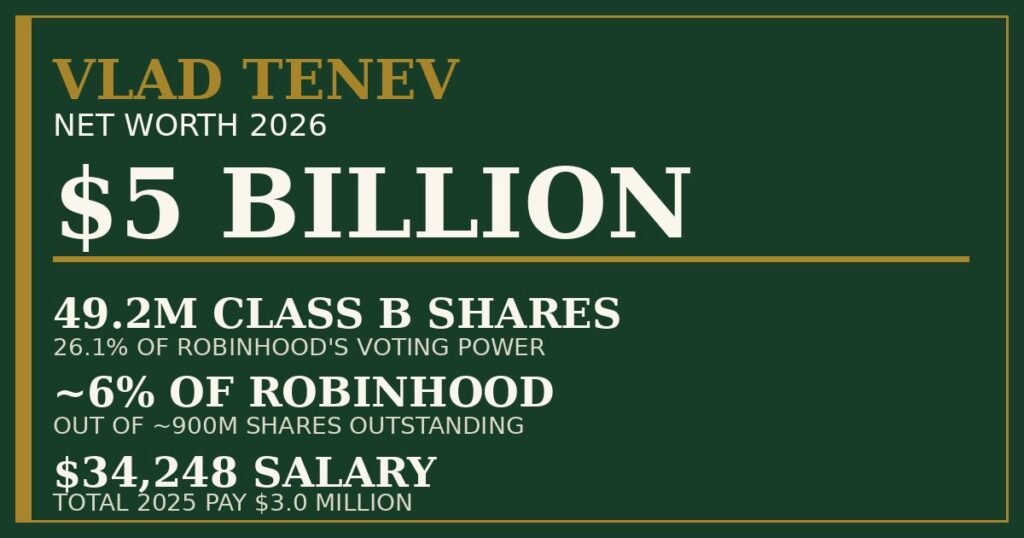
Quick Answer: As of 11 November 2026, Vlad Tenev’s net worth is estimated at $5 billion (range $4.5–$5.5 billion, Medium confidence). The estimate rests on Forbes’ latest real-time reading of $4.95 billion and on his 49.2 million Robinhood Class B shares — about 6% of the company — worth roughly $4 billion at the current share price.
Vlad Tenev Net Worth at a Glance
| Field | Detail |
|---|---|
| Estimated net worth | $5 billion |
| Range | $4.5–$5.5 billion |
| Confidence | Medium |
| Valuation date | 11 November 2026 |
| Primary source | Forbes real-time $4.95B + Robinhood proxy stake math |
What Is Vlad Tenev’s Net Worth in 2026?
Vlad Tenev’s net worth is estimated at $5 billion as of 11 November 2026, with a range of $4.5 billion to $5.5 billion and Medium confidence. The figure rests on Forbes’ latest real-time estimate of $4.95 billion (11 November 2026) and on Tenev’s roughly 6% stake in Robinhood, which is worth about $4 billion at the current share price.
The range is deliberately wide because the figure is a snapshot of a moving target. Robinhood (HOOD) closed at $81.33 on 10 November 2026, down from above $130 earlier in the year, and the company’s market capitalisation stood at about $73.2 billion. Every dollar move in the share price moves Tenev’s wealth by roughly $50 million, since his holding is close to 50 million shares. A reader checking this article in a month should expect a different number — and should check the date on it.
What Vlad Tenev net worth does not include is equally important. There is no publicly documented property portfolio, art collection or outside investment attached to Tenev’s name, so none is counted. His stake in Harmonic, the AI startup he co-founded in 2023, is not counted either: the company was valued at $1.45 billion in November 2025, but his ownership percentage has never been disclosed, so assigning it a value would be guesswork. Vlad Tenev net worth is therefore an estimate of his listed Robinhood stake plus the retained proceeds of shares he has sold — not a verified balance sheet.
How Did Vlad Tenev Build His Wealth?
Tenev built his wealth by co-founding Robinhood in 2013 and keeping roughly 6% of the company through its 2021 stock market listing, rather than by earning a large salary. His base pay is $34,248 a year, so Vlad Tenev net worth is almost entirely equity: the stake, plus about $1.1 billion gross from shares he has sold since 2021.
His path — code, not content — sets him apart from the creator fortunes WorthSum usually profiles, such as Airrack, who built a $10 million fortune from YouTube. Tenev and his Stanford friend Baiju Bhatt first built software for high-frequency trading firms, then used what they learned to build a brokerage that charged no commission. When Robinhood went public on 29 July 2021 at $38 a share, valuing the company at $32 billion, Tenev’s paper fortune was about $2.1 billion at the age of 34. The stock’s rise since then — driven by crypto trading, tokenisation and a push into prediction markets — did the rest.
The salary is a deliberate statement, not a hardship. Tenev cut his base pay from $400,000 to $34,248 in April 2021, matching the median wage of American workers that year, and the proxy statement records the same figure for 2023, 2024 and 2025. The real pay came earlier: in 2021 he received $794 million of his total compensation in stock awards, tied to the listing. A further package of market-based restricted stock units — potentially worth $4.7 billion if the share price reached $120 to $300 — was cancelled in 2023, producing a $485 million accounting charge.
How Much of Robinhood Does Vlad Tenev Own?
Tenev owns about 6% of Robinhood, according to Forbes, and the holding is documented precisely in the company’s own filings. According to the Fintechly dossier on Tenev’s proxy filings, Robinhood’s 2026 proxy statement records his beneficial ownership as 49,234,651 Class B shares as of 8 April 2026, carrying 26.1% of the company’s total voting power. Class B shares carry ten votes each, and Tenev and Bhatt together hold all of the outstanding Class B stock under a Founders’ Voting Agreement dated 26 July 2021 — so the founders hold about 12% of the shares but more than half of the votes.
| Component | Basis | Value at $81.33 (HOOD close, 10 Nov 2026) |
|---|---|---|
| Class B shares | 49,234,651 (proxy, 8 Apr 2026) | ~$4.00 billion |
| Class A shares | ~375,000 (Form 4 data, 28 Oct 2026) | ~$31 million |
| Total listed stake | ~$4.03 billion | |
| Shares sold since 2021 | 16.5 million shares, ~$1.1 billion gross | Pre-tax proceeds; retained amount undisclosed |
| Harmonic stake | Valuation $1.45 billion (Nov 2025) | Not counted — ownership % undisclosed |
The table explains why Forbes’ $4.95 billion is higher than the bare stake value: Tenev has sold 16.5 million shares since 2021 for an estimated $1.1 billion gross, and some of that money — after tax and spending, neither of which is disclosed — sits on top of the shares he still holds. The $5 billion estimate of Vlad Tenev net worth is the stake plus a reasonable allowance for those retained proceeds, and it matches Forbes’ independent figure within about $0.1 billion.
Two common mistakes are worth correcting here. First, Robinhood’s market capitalisation of about $73.2 billion is the value of the whole company, not of Tenev’s wealth — he owns about 6% of it. Second, the $1.1 billion figure sometimes quoted for Tenev counts only the shares tracked in his Form 4 insider filings; it misses the 49.2 million Class B shares entirely, so it is not his total wealth.
What Do Other Sources Say About Vlad Tenev’s Net Worth?
The published estimates for Vlad Tenev net worth move with Robinhood’s share price, so the dates matter more than the numbers. The table below shows the spread, and the pattern in it is the story: every figure is a Forbes real-time reading from a different date, and the latest is the lowest of 2026 because the stock fell sharply in the autumn.
The latest Forbes reading — $4.95 billion on 11 November 2026 — is tracked by Grizzly Bulls, and it is this article’s anchor because it is the most recent. Forbes’ own Iconoclast 50 list, published in 2026, carries him at $4.4 billion, while its January 2026 reading was $5.9 billion and its August 2026 reading was $5.7 billion. Those are not contradictions: they are snapshots of the same fortune at different share prices.
| Source | Figure | Date | Note |
|---|---|---|---|
| Forbes (real-time) | $4.95 billion | 11 Nov 2026 | Latest reading; this article’s anchor |
| Forbes (real-time) | $4.79 billion | 6 Nov 2026 | Superseded by the 11 Nov reading |
| Forbes (Iconoclast 50) | $4.4 billion | 2026 | Forbes list figure |
| Forbes (real-time) | $5.7 billion | Aug 2026 | When HOOD traded higher |
| Forbes (real-time) | $5.9 billion | 28 Jan 2026 | Higher HOOD price |
| Forbes (real-time) | $6.1 billion | 2025 | Fivefold surge year |
| LeaderPortfolio | $6.44 billion | 2026 | High outlier; page also shows $5.9B |
| QuiverQuant | $1.1 billion+ | 28 Oct 2026 | Form 4 direct holdings only — not total wealth |
| CEO.wiki | $1.2 billion | Dec 2025 | Stale; also gives the wrong birth date |
Two figures in that table deserve a specific warning. The $6.44 billion figure comes from a page that shows $5.9 billion in its own text, with no date on the higher number — it looks like a peak reading carried forward, not a current estimate. The $1.2 billion figure is stale and comes from a page that also gives Tenev’s birth date as 14 December 1987, when every other source agrees on 13 February 1987. Neither is used anywhere in this article.
How Much Does Vlad Tenev Earn as Robinhood CEO?
Tenev’s 2025 pay was $3,004,978 in total, made up of a $34,248 base salary plus $2,970,730 of other compensation — $1,722,904 for personal security, including residential security and online privacy services, and $1,247,826 for personal use of a private aircraft. He received no annual cash incentive and no new equity grants in 2025; the board’s proxy statement notes “no change to CEO compensation” that year.
The cash pay is almost irrelevant to his wealth. The real compensation event was 2021, when he received $794 million in stock awards around the IPO, as reported by the Motley Fool from Robinhood’s filings. The founders were also promised up to 22.2 million restricted stock units for Tenev, potentially worth $4.7 billion, if the share price hit targets between $120 and $300 — but that 2021 Founders Award was cancelled in 2023, before any of those targets were met, and the cancellation produced a $485 million accounting charge for the company.
Who Is Vlad Tenev?
Vlad Tenev — full name Vladimir Tenev — is a Bulgarian-American entrepreneur born on 13 February 1987 in Varna, Bulgaria, who moved to the United States at the age of five. His parents both worked for the World Bank, and he has described a frugal childhood shaped by the financial instability his family left behind in Bulgaria. He lives in Palo Alto, California, with his wife Celina and their three children.
He attended Thomas Jefferson High School for Science and Technology in Fairfax County, Virginia, then studied mathematics at Stanford University, where he met Baiju Bhatt, and earned a master’s degree in mathematics from UCLA in 2008. He had intended to study for a PhD in mathematics and pursue an academic career; instead he dropped out to build trading software with Bhatt. His biography records the same account across Stanford, UCLA and Forbes profiles, and the education is the least disputed part of his story.
Nothing is publicly documented about his parents or siblings by name, and the personal details that are public come from interviews rather than records: a fitness routine he credits with helping him manage stress, and a $125,000 donation in 2025 to the TJ Partnership Fund, his high school’s alumni fund, described as the largest donation in the school’s history.
How Did Vlad Tenev Start Robinhood?
Tenev started Robinhood with Baiju Bhatt in 2013, after two earlier fintech ventures, and the idea came from the 2008 financial crisis and the Occupy Wall Street movement that followed it. They had built Celeris, a high-frequency trading software company, in New York in 2010, then Chronos Research in January 2011, selling low-latency software to trading firms and banks, before moving to California later that year.
The brokerage’s premise was simple: trading should be free. They pitched the concept to about 75 investors while trying to raise the capital regulators required to operate as a registered broker-dealer, and secured early backing from venture capitalist Tim Draper — agreeing, in the process, to forgo their own salaries until the regulatory licence was approved. By the end of 2013 Robinhood had announced a brokerage with commission-free trading, and its waitlist, in Tenev’s words, “exploded”. The company’s name came from his wife, Celina, who described the two founders as “the Robin Hood of finance” while the app was in development.
The milestones that followed turned the idea into a fortune. Tenev and Bhatt became billionaires after a funding round in May 2018 that valued Robinhood at $6 billion; Tenev became sole CEO in November 2020, when Bhatt stepped down as co-CEO; and the company debuted on the Nasdaq on 29 July 2021 at $38 a share, a $32 billion valuation. He has said his goal for Robinhood is to become a “financial superapp” rivalling Fidelity and Charles Schwab, built on AI and blockchain technology.
What Happened With GameStop in 2021?
In January 2021, during the GameStop and AMC short squeezes, Robinhood restricted users from buying certain stocks and options on 28 January, citing an inability to meet federal clearinghouse deposit requirements. Tenev publicly defended the decision and apologised for the trading halt when he testified before the United States House Committee on Financial Services on 18 February 2021, while maintaining he had done nothing wrong.
The episode drew the heaviest regulatory punishment in the company’s history, but the fines fell on the company, not on Tenev personally. In December 2020 the SEC had already charged Robinhood with deceiving customers about its revenue sources, settling for $65 million; then on 30 June 2021 FINRA fined the company $70 million — a $57 million penalty, the largest in the regulator’s history, plus $12.6 million in restitution — for systemic supervisory failures, outages and false or misleading information.
The SEC later closed its investigation into the January 2021 trading restrictions with no action, advising the company in writing on 10 January 2025. The investigation had also touched Tenev personally: the US Attorney’s Office executed a search warrant for his cell phone, and he was named in subpoenas and requests for information from the DOJ, the SEC, FINRA and state regulators. Tenev was portrayed by Sebastian Stan in the 2023 film Dumb Money, a drama about the GameStop short squeeze.
What Happened to Alex Kearns?
In June 2020, 20-year-old Alexander Kearns died by suicide after his Robinhood account mistakenly displayed a negative balance of about $730,000 from an options trade. He had emailed customer support and called a helpline that was not staffed, and the error was only corrected after his death. Tenev apologised to his family at the February 2021 congressional hearing.
Kearns’ parents, Dan and Dorothy Kearns, filed a wrongful death lawsuit against Robinhood in January 2021, alleging the company offered no “meaningful customer support” to investors. During the same hearing, Representative Sean Casten played Robinhood’s 12-second helpline message — which ends in a hang-up — to show what users got when they called for help. Robinhood later expanded its live phone support, and Tenev told the hearing the company was adding customer support call centres.
Has Robinhood Been Fined Again Since GameStop?
Yes. Since the $70 million FINRA fine of 2021, Robinhood’s broker-dealers have paid a further $26 million FINRA penalty with about $3.76 million in restitution, and two broker-dealers paid $45 million over failures including off-channel communications. The SEC also sent Robinhood Crypto a Wells notice, but closed that investigation in February 2025 without action.
These are company penalties, not fines on Tenev personally — as with the 2021 fines. The pattern is the gap in most net-worth pages, which stop at GameStop: the enforcement story continued, and the Fintechly dossier records the later settlements and closures alongside the older cases.
What Is Harmonic?
Harmonic is the artificial-intelligence startup Tenev co-founded in 2023, where he serves as executive chairman, and it is his main venture outside Robinhood. Based in Palo Alto, its aim is to reduce AI hallucinations — the confident falsehoods chatbots produce — by generating and checking mathematical code, and to improve AI’s mathematical skills.
Its chatbot, Aristotle, answers mathematical questions with its reasoning shown, and by June 2024 it had posted an 83% success rate on a leading mathematical benchmark; in July 2025 it displayed what its makers called top-level performance at the International Mathematical Olympiad. Through November 2025 Harmonic had raised $295 million in total capital, creating a valuation of $1.45 billion. Tenev’s ownership percentage has never been disclosed, which is why no value for Harmonic appears anywhere in the estimate of Vlad Tenev net worth.
Vlad Tenev Net Worth Over Time
| Date | Forbes estimate | What moved it |
|---|---|---|
| May 2018 | ~$1 billion | Became a billionaire after the $6B funding round |
| Jul 2021 | ~$2.1 billion | IPO at $38 a share; $32B valuation |
| 2025 | $6.1 billion | Fivefold surge on the crypto and tokenisation push |
| 28 Jan 2026 | $5.9 billion | Forbes real-time reading |
| Aug 2026 | $5.7 billion | Forbes real-time reading |
| 6 Nov 2026 | $4.79 billion | HOOD fell about 25% in a month |
| 11 Nov 2026 | $4.95 billion | Latest Forbes real-time reading |
That kind of swing is unique to a founder whose wealth sits in one listed stock — the creator fortunes WorthSum profiles, like Ryan Trahan’s $15 million, are built on diversified content businesses rather than a single share price. Tenev lost nearly $1 billion of paper wealth between January and November 2026 without selling a share, hiring anyone or changing strategy; the market moved, and his fortune moved with it.
Vlad Tenev Net Worth — Timeline
| Year / Date | Event | Significance |
|---|---|---|
| 13 Feb 1987 | Born in Varna, Bulgaria | — |
| 1992 | Joins his parents in the US at age 5 | Raised in Virginia |
| 2008 | UCLA master’s degree in mathematics | Leaves a planned PhD to build startups |
| 2010 | Co-founds Celeris (high-frequency trading software) | First venture with Baiju Bhatt |
| Jan 2011 | Chronos Research | Sells low-latency software to banks |
| 2013 | Co-founds Robinhood | Commission-free trading |
| May 2018 | Becomes a billionaire | $6B valuation funding round |
| Nov 2020 | Becomes sole CEO | Bhatt steps down as co-CEO |
| Dec 2020 | SEC settles with Robinhood for $65M | Misleading customers on revenue sources |
| 28 Jan 2021 | Restricts GameStop buying | Clearinghouse deposit requirements |
| 18 Feb 2021 | Testifies before Congress | Apologises for the trading halt |
| 30 Jun 2021 | FINRA fines Robinhood $70M | Largest FINRA penalty ever |
| 29 Jul 2021 | Robinhood IPO ($38/share, $32B) | Worth ~$2.1B at 34 |
| 2023 | Co-founds Harmonic | AI startup; executive chairman |
| 2023 | 2021 Founders Award cancelled | $485M accounting charge |
| Nov 2025 | Harmonic valued at $1.45B | Series C fundraising |
| 2025 | Forbes 400; Fortune 100 Most Powerful People in Business | — |
| 2026 | Forbes Iconoclast 50 | $4.4B at list time |
Who Is Vlad Tenev Married To?
Tenev is married to Celina A. Tenev, a co-founder of Call9, an emergency-health service, and the couple have three children. She is the source of the Robinhood name: while the app was in development, she described Tenev and Bhatt as “the Robin Hood of finance”, and the name stuck.
He lives in Palo Alto, California, keeps his family life largely private, and is described as a fitness enthusiast who credits his training routine with helping him manage stress. He was invited to give the keynote address at UCLA’s 2019 mathematics commencement, and has spoken at Fortune Brainstorm Tech, the All-In Summit, TEDAI and TechCrunch Disrupt.
What Is Vlad Tenev Doing Now?
Tenev is remaking Robinhood into a diversified financial superapp for Generation Z and beyond, and the numbers show how far that push has gone. In 2025 the company hit a record $4.5 billion in revenue, with 11 business lines each generating more than $100 million a year, and in the third quarter of 2026 it reported record revenue of $1.42 billion, with 5.2 million Gold subscribers. The platform now offers advanced trading tools, AI features, banking, credit, wealth products, prediction markets and tokenised assets, and in 2026 it was named to Forbes’ inaugural Iconoclast 50 list.
His second act runs in parallel: Harmonic, the maths-focused AI startup, is now valued at $1.45 billion, and Tenev has argued publicly that every company will become an AI company — faster than every company became a tech company. Robinhood has also unveiled its own blockchain, the Robinhood Chain, and tokenised stocks in London, alongside acquisitions such as TradePMR and Bitstamp that push it into advisers and institutional crypto.
Among the young fortunes on this site, Jynxzi’s $6 million shows the other side of that coin: a fortune built by streaming on platforms, rather than by building the platform itself. As of November 2026 no new Robinhood equity award, sale or venture has emerged that would change Vlad Tenev net worth from the $5 billion estimate — the next event that could move it is the share price itself.
How Is Vlad Tenev’s Net Worth Estimated?
Net worth equals assets minus liabilities: add up what a person owns — cash, shares, property, business equity — and subtract what they owe. A salary is not net worth, and a company’s market capitalisation is not its founder’s wealth. For Tenev, the estimate starts with the one hard number: 49,234,651 Robinhood Class B shares, documented in the company’s 2026 proxy statement, worth about $4 billion at the 10 November 2026 closing price of $81.33.
On top of the stake sits a reasonable allowance for the shares he has already sold — 16.5 million shares since 2021 for about $1.1 billion gross — minus the tax and spending nobody can see. That allowance is why Forbes’ $4.95 billion sits above the bare $4.03 billion stake value, and why this article’s $5 billion estimate matches Forbes within about $0.1 billion.
What does not count is equally deliberate. His Harmonic stake is excluded because his ownership percentage has never been disclosed — a $1.45 billion company valuation tells you nothing about one person’s share of it. No property, car, art or outside investment is counted either, because none is publicly documented. And no liabilities are counted, because none are disclosed — a stated limitation, not an assumption of zero.
Three things make this estimate reliable enough for Medium confidence. First, the share count comes from an SEC filing, not a gossip site. Second, the price is a live market quote, so the stake math is reproducible by anyone. Third, Forbes’ independent estimate lands within $0.1 billion of the same build. The figure still moves daily with HOOD’s price, which is why the range is wide and the date is on the estimate.
How Does Vlad Tenev’s Net Worth Compare With Other Founders?
Tenev’s $5 billion sits just below fellow founder-billionaire Palmer Luckey’s $6 billion — both fortunes are single-company founder stakes, and both move with a valuation neither man controls. The gap to the creator fortunes below them is the point: Ryan Trahan, Airrack and Jynxzi built diversified content businesses worth $6–$15 million, while Tenev and Luckey built companies worth tens of billions and kept a slice. A founder’s fortune is bigger, and far more volatile — Tenev lost nearly $1 billion of paper wealth between January and November 2026 without selling a share.
| Person | Estimated net worth (Nov 2026) | Main wealth source |
|---|---|---|
| Palmer Luckey | $6 billion ($5.5–$6.5 billion) | Anduril + Oculus founder stake |
| Vlad Tenev | $5 billion ($4.5–$5.5 billion) | Robinhood founder stake |
| Ryan Trahan | $15 million | YouTube + Joyride candy |
| Airrack | $10 million | YouTube + Creator Now exit |
| Jynxzi | $6 million | Twitch streaming |
The peer figures above are WorthSum’s own estimates from November 2026. Luckey is the closest peer — another founder whose wealth is a single stake in a company he built — while the three creators show what a fortune looks like when it is built on content rather than equity: smaller, steadier, and far less exposed to one share price.
FAQs About Vlad Tenev’s Net Worth
How did Vlad Tenev become a billionaire?
By co-founding Robinhood in 2013 with Baiju Bhatt and keeping roughly 6% of the company through its 2021 listing. They became billionaires after a May 2018 funding round valued Robinhood at $6 billion.
How much of Robinhood does Vlad Tenev own?
About 6% of the company — 49,234,651 Class B shares, carrying 26.1% of the voting power, according to Robinhood’s 2026 proxy statement.
What is Vlad Tenev’s salary?
His base salary is $34,248 a year. His total 2025 pay was $3,004,978, mostly personal security and private aircraft use.
Is Vlad Tenev still the CEO of Robinhood?
Yes. He is the co-founder, Chairman and CEO, and has been sole CEO since November 2020.
What is Harmonic?
Harmonic is the AI startup Tenev co-founded in 2023, where he is executive chairman. It was valued at $1.45 billion in November 2025, but it is not counted in Vlad Tenev net worth because his ownership percentage is undisclosed.
What is Vlad Tenev’s net worth in 2026?
Vlad Tenev’s net worth is estimated at $5 billion as of 11 November 2026, with a range of $4.5 billion to $5.5 billion and Medium confidence.
Conclusion
At 39, Vlad Tenev owns about 6% of a company he started with a friend in 2013 — and that single stake is nearly his entire fortune. The $5 billion estimate is honest about what it is: a snapshot of a listed shareholding plus a reasonable allowance for shares already sold, dated 11 November 2026, and it will move with Robinhood’s share price.
The lesson of the number is concentration. One stock, one company, one price — that is how a fortune can fall by nearly $1 billion in ten months without its owner doing anything at all. For the other side of founder wealth, compare his path with Palmer Luckey, whose $6 billion Anduril and Oculus fortune rests on the same kind of single-company stake.
Last updated: 11 November 2026. Net worth figures presented in this article are estimates based on publicly available information. Actual personal wealth may differ because private assets, liabilities, ownership interests, and financial arrangements are not always publicly disclosed. This content is for informational purposes only and is not financial advice.
Pingback: Palmer Luckey Net Worth: Stunning Billionaire Fortune in 2026