
Palmer Luckey net worth is estimated at $6 billion as of 12 November 2026, with a range of $5.5 billion to $6.5 billion and Medium confidence. The 34-year-old entrepreneur is one of the rare founders to have built two billion-dollar companies in two completely different industries: he sold the virtual reality company Oculus VR to Facebook for about $2 billion at 21, then co-founded Anduril Industries, the defence technology company now valued in the tens of billions.
Almost all of that fortune sits in a single private company. Anduril has no public share price, so his fortune cannot be calculated the way a listed founder’s fortune can — it rests on Forbes’ estimate of his stake, and on the valuations investors have put on Anduril in its funding rounds.
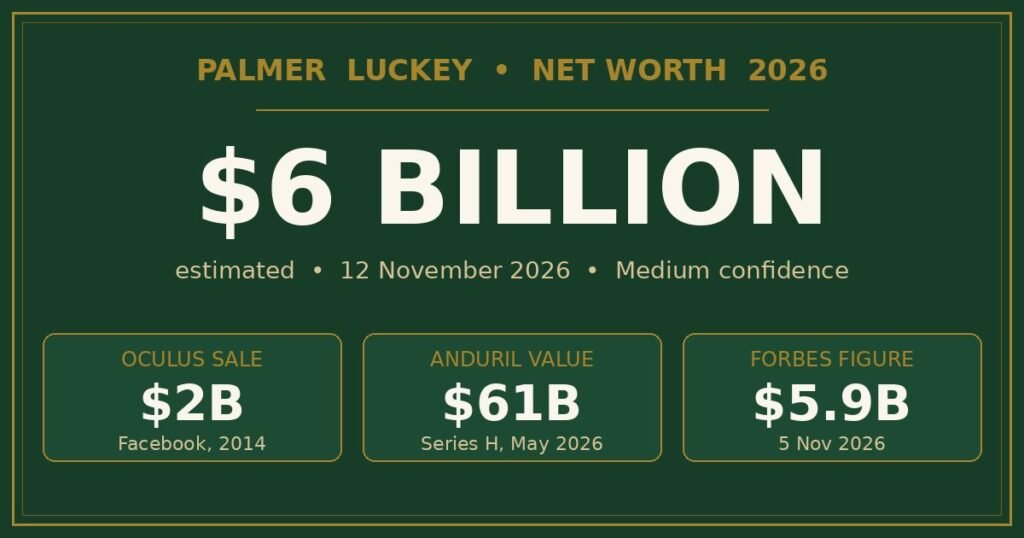
As of 12 November 2026, Palmer Luckey’s net worth is estimated at $6 billion (range $5.5–$6.5 billion, Medium confidence). The estimate is anchored on Forbes’ real-time reading of $5.9 billion from 5 November 2026, with the bulk of the fortune in his undisclosed stake in Anduril Industries, valued at $61 billion in May 2026.
Palmer Luckey Net Worth at a Glance
| Field | Detail |
|---|---|
| Estimated net worth | $6 billion |
| Range | $5.5–$6.5 billion |
| Confidence | Medium |
| Valuation date | 12 November 2026 |
| Primary source | Forbes real-time estimate, $5.9 billion (5 Nov 2026) |
What Is Palmer Luckey’s Net Worth in 2026?
Palmer Luckey’s net worth is estimated at $6 billion as of 12 November 2026, with a range of $5.5 billion to $6.5 billion and Medium confidence. The anchor is Forbes’ real-time estimate of $5.9 billion, last published on 5 November 2026, which also placed him at No. 287 on the 2026 Forbes 400 list of America’s richest people with the same $5.9 billion figure, measured as of 4 September 2026.
The range is wide because the figure is a snapshot of a private-company fortune. Anduril’s valuation has roughly doubled in most of its funding rounds — $14 billion in August 2024, $30.5 billion in June 2025, $61 billion in May 2026 — and an employee tender offer in October 2026 priced it at about $90 billion. If Forbes’ next reading reflects that higher mark, the estimate would move up; if the tender proves a peak, it would move down.
What Palmer Luckey net worth does not include is equally important. No property portfolio or outside investment is publicly documented, so none is counted, and his stake in Erebor Bank — the tech-focused bank he co-founded in 2025, valued at $4.35 billion that December — is not counted either, because his ownership percentage has never been disclosed. The estimate is therefore his Anduril stake plus the retained proceeds of the Oculus sale, not a verified balance sheet, and the Times of India profile of Luckey carries the same $5.9 billion Forbes figure dated 5 November 2026.
How Did Palmer Luckey Build His Wealth?
Luckey built his wealth by founding Oculus VR at 19, selling it to Facebook for about $2 billion at 21, then using the proceeds — and his reputation — to co-found Anduril Industries in 2017, whose valuation has since risen roughly 60-fold. The first fortune came from a consumer product; the second, much larger one from defence technology — a combination no other founder of his generation has matched.
His path runs through two different Silicon Valley playbooks. Oculus is the classic garage-to-exit tale: a teenager’s prototype, a $2.4 million Kickstarter campaign, and a landmark acquisition. Anduril is the opposite — a company that self-funds research and development, builds weapons systems first, and then sells the finished product to the Pentagon, a model Luckey calls a “defence product company” rather than a traditional contractor. The contrast with a listed founder is sharp: Vlad Tenev built a $5 billion fortune on a public stock anyone can price daily, while Luckey’s fortune is priced only when investors next value Anduril.
The salary tells the same story as the equity. Luckey told Bloomberg at CES in January 2026 that he pays himself $100,000 a year at Anduril — deliberately modest, because as he put it, “I also own a lot of my company.”
How Much of Anduril Does Palmer Luckey Own?
Nobody outside Anduril knows exactly how much of the company Luckey owns — the figure has never been publicly disclosed, and this article will not invent one. What the numbers do show is that his stake must be in the high single digits, and that is the key to Palmer Luckey net worth: at Anduril’s $61 billion Series H valuation, a $5.9 billion Forbes estimate, minus roughly $600 million of retained Oculus proceeds, implies a stake worth about $5.3 billion, or roughly 9% of the company.
That implied figure is consistent with the only public analysis of the question, which puts Luckey’s diluted founder equity at somewhere between 5% and 15% of the company, a range worth $3 billion to $9 billion at the $61 billion valuation. The spread is the whole story: every funding round dilutes the founders, and nine rounds have raised more than $11 billion since 2017, so the stake that was large at the founding has shrunk with each cheque even as the company became far more valuable.
| Component | Evidence | Value |
|---|---|---|
| Forbes estimate (anchor) | Real-time reading, 5 Nov 2026 | $5.9 billion |
| Implied Anduril stake | $5.9B minus ~$0.6B Oculus proceeds | ~$5.3 billion (about 9% of $61B) |
| Oculus proceeds (total, pre-tax) | $2B sale plus at least $100M settlement | ~$600 million |
| Erebor Bank stake | $4.35B valuation, Dec 2025 | Not counted — ownership % undisclosed |
| Warhound | Partner, no equity | $0 |
| Estimate | Forbes anchor, rounded | $6 billion (range $5.5–$6.5B) |
Two mistakes are worth correcting. First, Anduril’s $61 billion valuation — or the roughly $90 billion implied by the October 2026 employee tender — is the value of the whole company, not of Luckey’s wealth; he owns a fraction of it. Second, the tender was a secondary sale: employees sold up to $1.3 billion of their own shares at $94.80 each, so the $90 billion mark is a price for existing shares, not a funding round — a distinction SmartAsset’s Anduril tracker draws out.
What Do Other Sources Say About Palmer Luckey’s Net Worth?
The published estimates split into two groups, and the split is entirely about dates. The freshest figures cluster around $6 billion, while the pages still headlining $3.5 billion quote Forbes’ reading from February or May 2026 — before Anduril’s $61 billion Series H round in May doubled its valuation.
The latest Forbes reading — $5.9 billion on 5 November 2026 — is the anchor because it is the most recent, and the Grizzly Bulls tracker of the Forbes estimate corroborates it at $5.92 billion. Celebrity Net Worth also says $6 billion, but its page was last updated on 4 March 2026 and wrongly states that Oculus sold for “$2.7 billion” — a reminder that even a roughly right figure can sit on wrong facts.
| Source | Figure | Date | Note |
|---|---|---|---|
| Forbes (real-time) | $5.9 billion | 5 Nov 2026 | Latest reading; this article’s anchor |
| Forbes 400 | $5.9 billion | Sep 2026 | No. 287; values as of 4 Sep 2026 |
| Grizzly Bulls (Forbes tracker) | $5.92 billion | 2026 | Tracks the Forbes estimate |
| Celebrity Net Worth | $6 billion | 4 Mar 2026 | Secondary only; says Oculus sold for “$2.7B” — wrong |
| LeaderPortfolio | $5.99 billion | 2026 | Forbes Real-Time; rank #692 |
| networth.com | ~$6 billion | Oct 2026 | Forbes real-time; Forbes 400 No. 287 |
| Forbes (real-time) | $3.5 billion | Feb–May 2026 | Superseded by the $61B Series H |
| BBN Times | $3.5 billion | 2026 | Stale headline; uses the Feb 2026 Forbes figure |
| Built In | $3.5 billion | May 2026 | Stale; published before the Series H |
Two figures deserve a specific warning. BBN Times is the most detailed rival article, but its $3.5 billion headline is a February 2026 Forbes reading, it dates the $61 billion round to “March 2026” when it closed in May, and it claims Anduril had raised “over $7.8 billion” when the total is more than $11 billion. Built In’s $3.5 billion is equally stale, though its reporting on Anduril’s products and Luckey’s current work is strong.
How Much Does Palmer Luckey Earn?
Luckey’s cash pay is almost irrelevant to his wealth. He pays himself $100,000 a year at Anduril, a figure he volunteered to Bloomberg in January 2026 while discussing a proposed executive pay cap for defence contractors, and he has said the low salary is a choice because his wealth is in his ownership of the company.
The real money from his career came in two lump sums, not a salary. The first was the Oculus sale: Facebook’s $2 billion acquisition in 2014, plus a settlement of at least $100 million after his 2017 departure, which the Wall Street Journal reported he negotiated, brought his total Facebook-years payout to roughly $600 million in combined cash and stock. The second is paper wealth: his Anduril equity, which has no cash value until the company goes public or he sells shares in a tender.
Who Is Palmer Luckey?
Palmer Luckey is an American entrepreneur born Palmer Freeman Luckey on 19 September 1992 in Long Beach, California, the eldest of four children. His father worked at a car dealership, his mother homeschooled him, and by his early teens he was taking college courses while building railguns, Tesla coils and lasers in his family’s garage — projects that, by his own account, sometimes left him injured.
He later attended California State University, Long Beach, where he majored in journalism and was online editor of the student newspaper, the Daily Forty-Niner, and worked part-time as an engineer in the University of Southern California’s Mixed Reality Lab, designing low-cost virtual reality systems for BRAVEMIND, a U.S. Army programme for veterans with post-traumatic stress disorder. His biography records the same account across interviews and institutional sources.
Two details from his teenage years explain the fortune behind Palmer Luckey net worth. He built more than 50 virtual reality headsets by the age of 19, funding the work with at least $36,000 he earned fixing and reselling damaged iPhones, plus part-time work as a groundskeeper, sailing coach and computer repair technician. And in 2009, at 16, he founded the ModRetro Forums, an online community for “portabilization” — turning old game consoles into portable devices — a hobby that would become a company fifteen years later.
How Did Palmer Luckey Start Oculus?
Luckey started Oculus by solving a problem nobody else thought was solvable: the virtual reality headsets of the late 2000s were bulky, low-resolution, slow and ruinously expensive, so from the age of 16 he began building his own in his parents’ garage, using cheap smartphone screens and lenses for a wide field of view and low latency. His sixth-generation prototype, the Oculus Rift, was good enough that John Carmack of id Software asked to borrow one, and demonstrated it running Doom 3 at E3 in 2012 — the moment the Rift went from a hobby project to a company.
He founded Oculus VR in April 2012 with Brendan Iribe, Michael Antonov and Nate Mitchell, and launched a Kickstarter campaign that August asking for $250,000. It raised $2.4 million — 974% of its target — with endorsements from Valve’s Gabe Newell and Carmack, and Luckey dropped out of university to work on it full-time.
The consumer Rift reached buyers in 2016, but by then the company belonged to Facebook: on 25 March 2014 it announced it would acquire Oculus VR for about $2 billion — $400 million in cash and 23.1 million Facebook shares worth about $1.6 billion, plus a further $300 million if the company hit performance milestones — and the deal closed in July 2014. His personal share of the proceeds was never made public, but Forbes estimated Palmer Luckey net worth at $700 million in 2015, based on his equity at the time of the sale.
Why Was Palmer Luckey Fired From Facebook?
Luckey left Facebook in March 2017, and the reason remains disputed. In September 2016, the Daily Beast reported he had donated about $10,000 to Nimble America, a pro-Donald Trump group behind a single Pittsburgh billboard mocking Hillary Clinton; Luckey later put the figure at $9,000. The donation set off a backlash among developers and inside Facebook, and he was put on leave and sidelined from Oculus decisions before his departure was confirmed on 30 March 2017, as Britannica’s profile of Luckey records.
Facebook has never given a public reason for the departure, and the two sides’ accounts still conflict. Luckey has said he was fired because of his political activity, and internal Facebook emails obtained by the Wall Street Journal in November 2018 suggested the matter was discussed at the highest levels, with executives including Mark Zuckerberg reportedly pressing him to support libertarian candidate Gary Johnson instead of Trump.
Facebook has said unequivocally that the departure was not due to his political views, and Zuckerberg, asked directly by Senator Ted Cruz in Senate testimony in April 2018 why Luckey had been fired, refused to discuss what he called a personnel matter. After leaving, Luckey hired an employment lawyer and negotiated a payout of at least $100 million, arguing the company had violated California law — a figure neither side has confirmed, and one the MIT Technology Review’s account of the ousting notes Meta has never explained.
The firing also overlapped with a separate legal fight. Shortly after the acquisition, ZeniMax Media sued Oculus, claiming it had used ZeniMax’s trade secrets and code; in February 2017 a jury found Luckey had violated a non-disclosure agreement but awarded no damages on that charge, and awarded $500 million in total against Oculus, Facebook and Luckey, with Luckey responsible for $50 million. A judge later cut the award, and the case settled in December 2018 on undisclosed terms.
What Is Anduril Industries?
Anduril Industries is the defence technology company Luckey co-founded in June 2017 with Trae Stephens, Matt Grimm, Brian Schimpf and Joseph Chen, named after Aragorn’s sword in The Lord of the Rings. Its premise was that Silicon Valley’s way of building technology — self-funded research, rapid iteration, software first — could work for weapons, where the traditional model has the taxpayer fund years of development before a product exists. At the centre is Lattice, an AI platform that fuses data from cameras, radar and other sensors into a single real-time picture of a battlefield, so autonomous systems can detect and respond to threats with minimal human involvement.
The product list has grown from a single surveillance tower into a catalogue: Sentry autonomous surveillance towers, first deployed at the U.S.-Mexico border, where a 2018 pilot caught 55 attempted entrants in its first 12 days; Ghost reconnaissance drones; Roadrunner interceptor drones; Barracuda cruise missiles; Fury, an unmanned AI fighter jet; and Dive, an autonomous underwater vehicle. The contracts followed: a $967 million Air Force contract in September 2020, a $1 billion Special Operations Command contract in February 2022, and a 10-year U.S. Army enterprise agreement worth up to $20 billion signed on 13 March 2026.
The funding tells the same story in numbers. Anduril was valued at about $1 billion in 2019, $4.7 billion in 2021, $8.5 billion in 2022, $14 billion in August 2024, $30.5 billion after a $2.5 billion Series G round led by Founders Fund in June 2025, and $61 billion after a $5 billion Series H round co-led by Thrive Capital and Andreessen Horowitz in May 2026 — a funding history tracked round by round in RevenueMemo’s Anduril financing record.
Revenue roughly doubled each year — about $1 billion in 2024 and about $2.2 billion in 2025, with guidance pointing to about $4.3 billion in 2026 — though the company is still loss-making and does not expect a profit before about 2030. In July 2026, Reuters reported Anduril was in talks to raise a new round at about $100 billion; no such round had closed by the valuation date.
What Is Palmer Luckey Doing Now?
Luckey is the public face of Anduril, while day-to-day operations are led by chief executive and co-founder Brian Schimpf, and his role is strategy, politics and promotion — meeting lawmakers and Pentagon officials and arguing that American defence procurement is too slow and too expensive, a role Built In’s profile of Luckey describes in detail.
In 2026, Defence Secretary Pete Hegseth appointed him, Elon Musk and former House Speaker Newt Gingrich to a panel studying the “battlefields of the future”, with 120 days to deliver findings. Anduril is also building Arsenal-1, a 5-million-square-foot autonomous weapons factory near Columbus, Ohio, expected to create more than 4,000 jobs, and in October 2026 it committed $3.7 billion to a second factory, Arsenal-2, in Maryland.
His newer ventures sit outside Anduril. He co-founded Erebor Bank with Palantir co-founder Joe Lonsdale in 2025, a nationally chartered bank for technology, defence and crypto companies, which raised $350 million at a $4.35 billion valuation in December 2025 and opened in February 2026. He also relaunched ModRetro as a hardware company in June 2024, selling the Chromatic, a handheld that plays original Game Boy cartridges, and the M64, a recreation of the Nintendo 64 — a business the Financial Times has reported as worth about $1 billion.
And in October 2026 he and Colossal Biosciences chief Ben Lamm launched Warhound, a company aiming to genetically engineer working dogs for the military and police, which raised $200 million at a $1.2 billion valuation; Luckey is a partner in the venture but holds no equity in it, so it adds nothing to Palmer Luckey net worth.
The scale of that operation is what sets him apart from the creator fortunes WorthSum usually profiles: Ryan Trahan’s $15 million was built by filming videos, while Luckey’s $6 billion was built by selling hardware to the Pentagon. As of November 2026 no new Anduril funding round, IPO filing or stake sale has emerged that would change the estimate — the next event that could move it is Forbes’ next reading, which may reflect the $90 billion tender.
How Is Palmer Luckey’s Net Worth Estimated?
Net worth equals assets minus liabilities: what a person owns, less what they owe. For a private-company founder, that means the value of his shares, plus cash and other assets, less any debts — not the value of the company, and not the gross money that once passed through his hands.
What counts is Luckey’s implied Anduril stake — about $5.3 billion at the $61 billion Series H valuation, after subtracting roughly $600 million of retained Oculus-era proceeds — plus those proceeds themselves. What does not count is the $61 billion Anduril valuation itself — the whole company’s value, not his; his Erebor Bank stake, whose ownership percentage is undisclosed; Warhound, in which he holds no equity; and any property, investment or liability, none of which has ever been publicly documented.
Three things make this estimate reliable. First, the anchor is Forbes’ $5.9 billion reading, corroborated within $100 million by three independent trackers. Second, the implied-stake arithmetic is internally consistent: a stake in the high single digits sits inside the only published analyst range of 5–15%. Third, the estimate is honest about its limits — Medium confidence, because the ownership percentage and the retained Oculus proceeds are undisclosed, and a private valuation mark can move the figure by hundreds of millions overnight.
How Does Palmer Luckey’s Net Worth Compare With Other Founders and Creators?
Luckey’s $6 billion sits in a different league from the creator fortunes WorthSum usually profiles — and close to the only other founder-billionaire on the site. The gap is not about fame or audience size; it is about what the fortune is made of. Luckey owns equity in a defence company valued in the tens of billions, against audiences and businesses measured in millions.
| Person | Estimated net worth (Nov 2026) | Main wealth source | Confidence |
|---|---|---|---|
| Palmer Luckey | $6 billion ($5.5–$6.5B) | Anduril stake + Oculus proceeds | Medium |
| Vlad Tenev | $5 billion ($4.5–$5.5B) | Robinhood stock (public) | Medium |
| Ryan Trahan | $15 million ($12–$18M) | YouTube + Joyride candy stake | Medium |
| Airrack | $10 million ($8–$12M) | YouTube + Creator Now exit | Medium |
Vlad Tenev is the closest peer: another founder whose fortune rests on one company — a public one, whose share price is visible every trading day, while Anduril’s value is set only when investors next price it. Ryan Trahan and Airrack show the other end of the scale: fortunes built video by video, worth roughly a four-hundredth of Luckey’s, yet built on audiences in the tens of millions. The comparison is the point — in net worth, the vehicle matters more than the following.
Palmer Luckey Net Worth Over Time
| Date | Forbes estimate | What moved it |
|---|---|---|
| 2015 | $700 million | Oculus sale proceeds; Forbes’ first estimate |
| 2016 | ~$700 million–$1 billion | Ranked No. 22 on Forbes’ richest entrepreneurs under 40 |
| 2021 | ~$1 billion | Anduril’s valuation first pushed his equity past $1B |
| Feb 2026 | $3.5 billion | Anduril at $30.5B; Forbes real-time reading |
| May 2026 | $3.5 billion | Still the published figure before the Series H |
| Sep 2026 | $5.9 billion | Forbes 400; Anduril at $61B |
| 5 Nov 2026 | $5.9 billion | Latest Forbes real-time reading |
| 12 Nov 2026 | $6 billion (estimate) | This article’s valuation date |
That kind of jump — $3.5 billion to $5.9 billion in seven months — is unique to a founder whose wealth sits in one private company that keeps doubling its valuation, and the opposite of the slow compounding behind the creator fortunes on this site, such as Airrack’s $10 million, built video by video over years. Luckey gained about $2.4 billion of paper wealth between February and September 2026 without selling a share or changing strategy; investors repriced his company, and his fortune moved with it.
Palmer Luckey Net Worth — Career Timeline
| Year / Date | Event | Significance |
|---|---|---|
| 19 Sep 1992 | Born in Long Beach, California | Eldest of four children |
| 2009 | Founds ModRetro Forums; begins building VR headsets | First venture; first Rift prototypes |
| Apr 2012 | Founds Oculus VR | With Iribe, Antonov and Mitchell |
| Aug 2012 | Oculus Rift Kickstarter raises $2.4M | 974% of its $250,000 target |
| 25 Mar 2014 | Facebook announces Oculus acquisition (~$2B) | $400M cash + $1.6B stock + $300M earn-out |
| Jul 2014 | Acquisition closes | Luckey becomes a Facebook employee |
| 2015 | Forbes estimates his net worth at $700M | First Forbes estimate |
| 2016 | Donates ~$10,000 to Nimble America | Triggers the controversy that ends his Facebook career |
| 2 Feb 2017 | ZeniMax jury awards $500M against Oculus et al. | Luckey responsible for $50M |
| 30 Mar 2017 | Leaves Facebook | No public reason given |
| Jun 2017 | Co-founds Anduril Industries | With Stephens, Grimm, Schimpf and Chen |
| Sep 2020 | Anduril wins $967M Air Force contract | Advanced Battle Management Systems |
| Feb 2022 | Anduril wins $1B SOCOM contract | Counter-drone work |
| Jun 2024 | Relaunches ModRetro as a hardware company | Chromatic handheld |
| 2025 | Co-founds Erebor Bank | With Joe Lonsdale |
| Dec 2025 | Sanctioned by China over Taiwan arms sales | Described by the WSJ as largely symbolic |
| 13 Mar 2026 | U.S. Army awards Anduril up to $20B over 10 years | Largest contract to date |
| Sep 2026 | Forbes 400 debut at $5.9B (No. 287) | Second-youngest on the list |
| Oct 2026 | Employee tender prices Anduril at ~$90B | $94.80/share; up to $1.3B; closes 9 Nov |
| Oct 2026 | Co-founds Warhound with Ben Lamm | $200M seed; Luckey holds no equity |
| 12 Nov 2026 | Valuation date for this article | Estimate $6B (range $5.5–$6.5B) |
Who Is Palmer Luckey Married To?
Luckey is married to Nicole Edelmann Luckey, a cosplayer and gamer he has known since his Oculus years; the couple married in 2019 and welcomed their first child in 2024. He is known for a deliberately casual public image — Hawaiian shirts and flip-flops even at Pentagon briefings, frequently barefoot — and for a collection of military hardware that includes a retired U.S. Navy Special Operations boat and several helicopters.
His family sits close to American politics: his younger sister Ginger married former U.S. Congressman Matt Gaetz in 2021, and Luckey himself is a prominent Republican donor who gave to all three of Donald Trump’s presidential campaigns. He has said he is staying in California despite opposing the state’s proposed billionaire tax, telling reporters in October 2026 that he is “not running” and wants to fight for the state where he built both companies.
FAQs About Palmer Luckey’s Net Worth
How much of Anduril does Palmer Luckey own?
His ownership percentage has never been publicly disclosed. The published figures imply a stake in the high single digits, worth roughly $5 billion at Anduril’s $61 billion valuation.
How did Palmer Luckey become a billionaire?
By founding Oculus VR in 2012 and selling it to Facebook for about $2 billion in 2014, then co-founding Anduril Industries in 2017 — the stake from that founding is the core of his fortune today.
Why was Palmer Luckey fired from Facebook?
No public reason was ever given. He left in March 2017 after his $10,000 donation to a pro-Trump group became public; he says it was political, Facebook says it was not.
What is Anduril Industries worth?
Anduril was valued at $61 billion in its May 2026 Series H round, and an October 2026 employee tender priced it at about $90 billion — but that is the company’s value, not Luckey’s personal wealth.
How much does Palmer Luckey earn?
He pays himself $100,000 a year at Anduril, a figure he volunteered to Bloomberg in January 2026. His wealth is in his equity, not his salary.
Is Palmer Luckey still involved with Oculus?
No. He left Facebook in March 2017, and Oculus is now part of Meta as the Meta Quest business. His defence company, Anduril, now works with Meta on military virtual reality.
Who is Palmer Luckey married to?
Nicole Edelmann Luckey, a cosplayer and gamer he has known since his Oculus years. They married in 2019 and welcomed their first child in 2024.
Conclusion
Palmer Luckey’s $6 billion is a fortune built twice: once on a $2 billion sale at 21, and again on a defence company investors now value at $61 billion — and possibly $90 billion. The number is real but fragile: it moves every time Anduril is repriced, and nobody outside the company knows exactly how much of it he owns.
That is why the honest headline is a range — $6 billion, $5.5–$6.5 billion, Medium confidence, valued 12 November 2026 — anchored on Forbes’ $5.9 billion reading and checked against the stake arithmetic. If Forbes’ next reading reflects the $90 billion tender, expect the estimate to move up.
To see how a public-company fortune compares, look at Vlad Tenev — or, for the opposite end of the scale, Ryan Trahan and Airrack.
Last updated: 12 November 2026. Net worth figures presented in this article are estimates based on publicly available information. Actual personal wealth may differ because private assets, liabilities, ownership interests, and financial arrangements are not always publicly disclosed. This content is for informational purposes only and is not financial advice.